


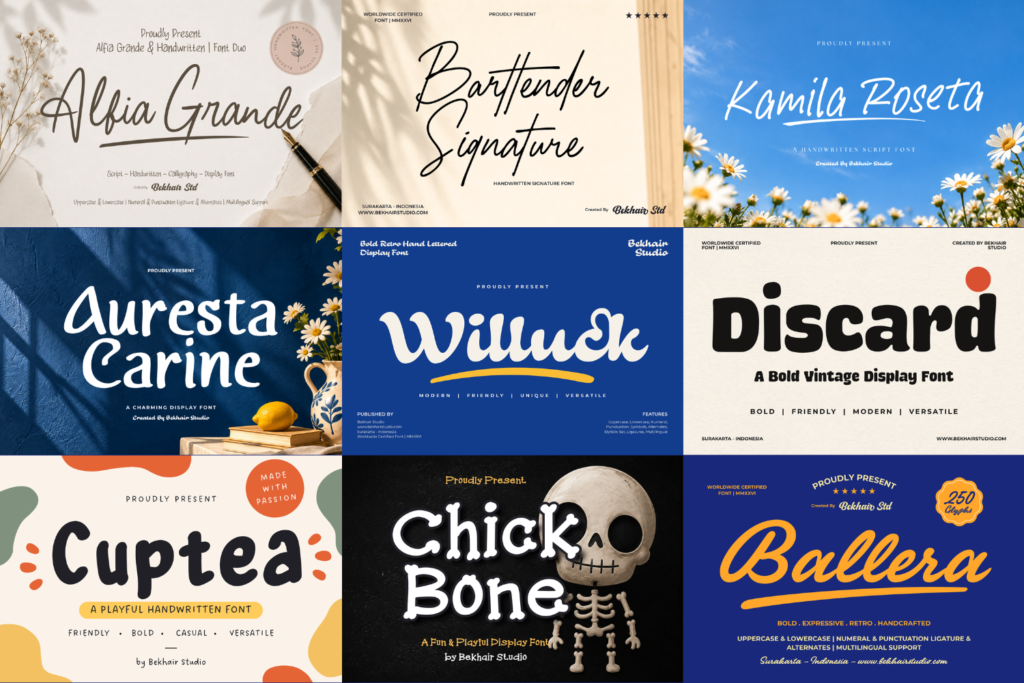
The Evolution of Fonts in 2027: The Future of Typography
Typography has always evolved alongside technology, culture, and visual communication. As digital experiences become more immersive and intelligent, the year 2027 is expected to bring another significant transformation to the world of fonts.
From artificial intelligence and variable typography to responsive interfaces and personalized branding, fonts are increasingly becoming more than static visual assets. They are becoming flexible design systems capable of adapting to different environments, audiences, and technologies.
1. AI and the Future of Font Design
One of the most influential developments shaping typography in 2027 is expected to be the continued integration of artificial intelligence into the design process.
AI-powered tools can assist designers in generating concepts, exploring letterform variations, analyzing readability, and creating alternative styles. Rather than completely replacing type designers, these technologies can function as creative assistants, allowing designers to explore a much larger number of possibilities in less time.
AI may also make font customization more accessible. Designers could potentially modify characteristics such as stroke contrast, width, curvature, proportions, and spacing according to the requirements of a specific project.
The result could be a new generation of highly personalized typefaces designed around individual brands, products, and creative identities.
2. Variable Fonts Become More Mainstream
Variable fonts are likely to play an even larger role in typography in 2027.
Unlike traditional font families that require separate files for different weights and styles, variable fonts can contain multiple variations within a single font file. Designers can adjust characteristics such as weight, width, optical size, and slant along continuous axes.
This flexibility is particularly valuable for websites, applications, digital advertising, and responsive interfaces.
A single typeface could automatically adapt from a compact mobile display to a large desktop headline while maintaining its visual identity.
As digital platforms continue to demand performance and flexibility, variable typography is likely to become increasingly common.
3. Responsive Typography
In 2027, typography is expected to become even more responsive.
Modern interfaces exist across smartphones, tablets, desktops, smart displays, vehicles, wearable devices, and other connected screens. A fixed typographic system may not provide the ideal experience across all of these environments.
Responsive fonts can adjust according to screen size, viewing distance, resolution, and layout.
For example, a typeface used in a mobile interface could become slightly wider and more open at smaller sizes to improve readability. The same typeface could become more compact and expressive when displayed as a large headline.
This approach transforms typography from a static element into an adaptive part of the user experience.
4. Personalization and Custom Brand Fonts
Branding is another area where typography is expected to become increasingly personalized.
In a crowded digital marketplace, companies need recognizable visual identities. Custom fonts provide brands with a way to create a distinctive voice that cannot easily be replicated by using generic typefaces.
By 2027, more brands may adopt custom or semi-custom type systems designed specifically for their products and audiences.
These systems may include multiple styles, languages, weights, widths, and responsive variations while maintaining a consistent brand personality.
Typography could therefore become one of the most important components of a complete brand identity.
5. The Return of Expressive and Decorative Fonts
Technology may become more advanced, but expressive typography is unlikely to disappear.
In fact, the growing use of standardized digital interfaces may increase demand for fonts with strong personalities.
Decorative, retro, futuristic, psychedelic, experimental, handwritten, and nostalgic typefaces can help brands stand apart from clean and predictable digital aesthetics.
Designers may increasingly combine modern technology with visual references from previous decades, creating typography that feels both familiar and contemporary.
This could lead to a renewed interest in distinctive display fonts, especially for packaging, fashion, entertainment, posters, social media, and lifestyle brands.
6. Variable Display Fonts and Kinetic Typography
The combination of variable fonts and motion design could create new opportunities for animated typography.
Instead of simply changing size or position, letters can gradually transform their weight, width, contrast, or shape during an animation.
For example, a lightweight typeface could smoothly transition into a bold display style as a user interacts with a website. A headline could expand, compress, or change its visual character according to movement and interaction.
This creates a relationship between typography and motion that was difficult to achieve with traditional static fonts.
Kinetic typography could become increasingly important in advertising, digital storytelling, entertainment, social media, and interactive experiences.
7. Typography for Immersive Experiences
The expansion of augmented reality, virtual reality, spatial computing, and immersive interfaces will create new challenges for type designers.
Typography designed for a flat screen does not necessarily work perfectly in a three-dimensional environment.
Fonts used in immersive interfaces need to consider viewing distance, perspective, lighting, depth, movement, and spatial positioning.
Designers may therefore develop typefaces specifically optimized for three-dimensional and spatial environments.
This could create an entirely new category of typography designed for virtual spaces, games, digital environments, wearable technology, and interactive installations.
8. Multilingual and Global Typography
As digital products reach international audiences, multilingual typography will remain an important area of development.
Font families will increasingly need to support multiple writing systems while maintaining a coherent visual identity.
Latin, Cyrillic, Greek, Arabic, Devanagari, Chinese, Japanese, Korean, and other scripts may need to work together within the same brand system.
The challenge is not simply adding more characters. Designers must carefully consider proportions, rhythm, spacing, stroke characteristics, and cultural conventions across different writing systems.
The future of typography will therefore require greater attention to global and inclusive type design.
9. Accessibility and Readability
As typography becomes more technologically advanced, accessibility will remain a fundamental consideration.
Designers are increasingly aware that beautiful typography must also communicate effectively.
Font selection, spacing, contrast, character differentiation, and responsive sizing can significantly influence how easily information can be understood.
In 2027, accessible typography is likely to become an even more important part of digital product design.
The goal will not simply be to create visually impressive fonts, but to create type systems that can communicate effectively with a wider range of users and viewing conditions.
10. Sustainability in Font Technology
Sustainability may also influence digital typography.
As websites and applications become increasingly complex, designers and developers are paying greater attention to performance and file efficiency.
Variable fonts can potentially help reduce the number of separate font files required by a digital project. Better font compression and more efficient web delivery can also contribute to faster-loading experiences.
For digital products with millions of users, even small improvements in efficiency can become significant at scale.
Typography may therefore become part of a broader conversation about sustainable digital design.
11. The Human Touch Will Remain Important
Despite advances in artificial intelligence and automation, human creativity will continue to play an essential role in type design.
A font is not simply a collection of technically optimized shapes. It can communicate history, emotion, culture, personality, and attitude.
Human designers understand cultural references, visual nuance, storytelling, and emotional context in ways that cannot always be reduced to technical parameters.
The most interesting typefaces of 2027 may therefore come from collaboration between human creativity and intelligent technology rather than from either one alone.
Conclusion
The evolution of fonts in 2027 is likely to be defined by flexibility, personalization, technology, and creativity.
AI-assisted design, variable fonts, responsive typography, immersive interfaces, multilingual systems, accessibility, and motion-based typography may all contribute to a rapidly changing typographic landscape.
At the same time, expressive display fonts, handcrafted styles, nostalgia, and human creativity will continue to give typography its emotional character.
The future of typography may not be about choosing between t